


Newell Normand
Folks, the Trump administration is weighing another extension of its Jones Act waiver as it looks for ways to ease shipping bottlenecks and keep energy prices in check. Supporters argue it could lower transportation costs, while our local maritime industries say it threatens America’s maritime industry in a number of ways. Joining us is Jennifer Carpenter, president and CEO of the American Waterways Operators. Jennifer, welcome to the show.
Jennifer Carpenter
Thanks so much, Newell. I really appreciate the opportunity, because this waiver is something that not just the American maritime industry should care about, but any American who cares about American jobs, border security, and, frankly, the American taxpayer getting a fair deal.
We’re getting scammed by this thing.
Newell Normand
Yeah, you know, Jennifer, I’ve kind of been all over the map on this issue, to be honest. I had some friends in the shipping industry — local shipping industry — approach me about it. We had some discussions, I began to do research, and I agree with you: this is not good, and I don’t understand why the president is doing what he’s doing.
So, if you would, for the benefit of the listening audience, let’s first talk about this and who else does it. Because I understand there’s this notion of cabotage, where there are 107 or 108 countries that protect themselves the same way we do with the Jones Act, right?
Jennifer Carpenter
Yeah, that’s exactly right, Newell. There are countries around the world — representing, you know, about 85% of the world’s coastline — that have similar laws. But I think an example that might resonate even more with your listeners is to talk for a minute about other transportation modes within the U.S. You cannot take Air China, or Lion Air, or Aeroflot between Atlanta and Dallas–Fort Worth. You cannot go terminal to terminal along I-10 in a Mexican truck driven by a Mexican driver. You can’t do that, and that’s essentially what’s happened here.
Try to imagine, using my aviation example, if at the beginning of this war the White House had said, “We’re concerned that jet fuel prices may go up, so we want to make sure Americans have maximum opportunity when it comes to air carriers — so we’re going to get rid of aviation cabotage,” and you could fly Lion Air, with its shaky safety record, between Charlotte and Chicago. Unthinkable — absolutely unthinkable. But that’s what we’ve done here. We have thrown open our maritime border, and other countries are not doing that.
You mentioned other countries around the world having similar laws — since COVID, we’ve seen a significant increase in the number of countries with those laws, because folks looked around and said, “Whether for supply chain security or homeland security, we’d better maintain our ability to move product between points in our own country.”
Newell Normand
Yeah, and in this country, the standards we have — as it relates to shipping, the quality of the vessels, the safety mechanisms, and everything else — are far superior to what other countries require and rely on, right?
Jennifer Carpenter
That’s true. And what’s really strange here, and makes this even more egregious, is that under this Jones Act waiver, we now have foreign vessels operating in the domestic commerce of the U.S. — essentially like little sovereign islands — and they are not complying with our laws. Imagine you’re running a land-based business: you’re paying U.S. taxes — federal, state, and local — you’re paying your workers minimum wage, you’re complying with local environmental standards. And then somebody sets up shop right across the street from you under a so-called waiver, under which they don’t pay taxes, they can go to the Home Depot parking lot and hire whoever they want — who cares if they have papers — and they don’t have to comply with safety or environmental standards.
That’s crazy.
Or, let’s say they don’t even do that, but they threaten to come in and do it while they negotiate with you over prices. Those things are happening right now in the maritime sphere with this Jones Act waiver, and it’s not fair.
Newell Normand
So, for the benefit of the listening audience — because I’m getting a bunch of texts — if you would, briefly explain what the Jones Act is.
Jennifer Carpenter
Absolutely. The Jones Act is a law that says: if you’re moving cargo by water in the United States — whether that’s points on the Mississippi River or coastal ports — that cargo needs to move on a vessel that is owned by Americans, built in the U.S., flies the U.S. flag, and employs American mariners. Not a radical concept.
Newell Normand
No — so, where are we now? I guess we’ve already reached the 60-day waiver that was issued. Is it about to expire? I thought it had already expired. Has it?
Jennifer Carpenter
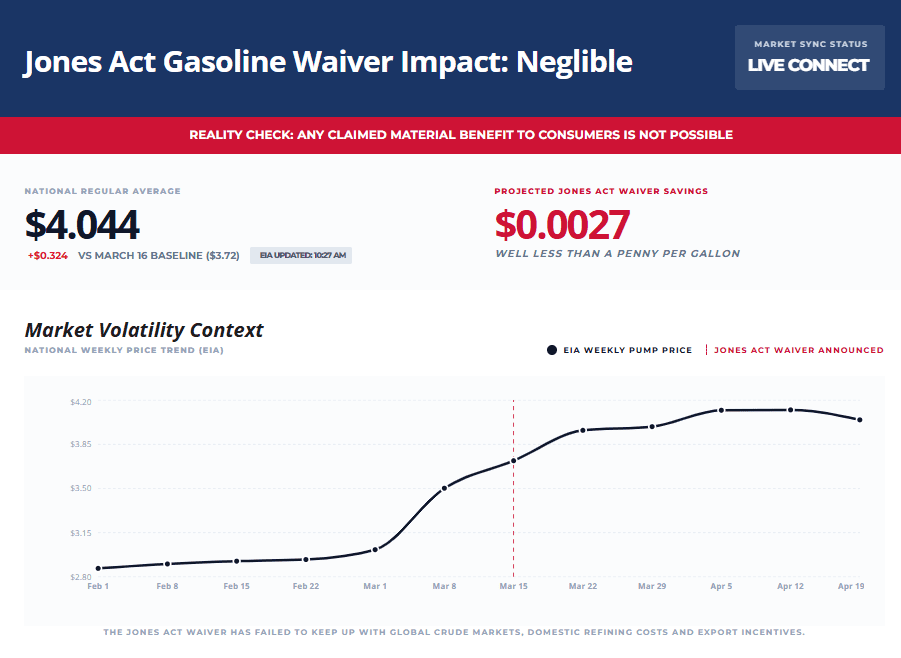
Here’s the timeline: the waiver was initially issued in March for a period of 60 days, and then, before that period even expired, the administration extended it in April for another 90 days. It’s now due to expire in mid-August, but you’ve probably seen reporting from Reuters and Bloomberg that the White House is considering extending it again, which would be egregious. Because, in addition to everything I’ve just said about the radical unfairness of this — and I’d say the un-Americanness of allowing foreign entities to come in here and pull jobs out from under Americans — we now have empirical data showing that this hasn’t worked.
Did it bring down the price of gas at the pump? It did not.
Your average American filling up his truck is paying about 40 bucks more.
That never had anything to do with the Jones Act — it had to do with crude oil supply and price, and we now know the Jones Act waiver didn’t do a thing about that. Then we were told we needed this waiver because parts of the U.S. might experience fuel shortages, and we’d need to move product around the country.
Well, we’ve now had about 120 days of experience under this waiver, and in that entire time, we’ve moved around the U.S. under the waiver about the same amount we export in three or four days. We are exporting record amounts of crude oil and petroleum products — and that’s great, the world needs it. But let’s not kid ourselves that a Jones Act waiver was needed for that. If we were having supply shortages at home, there would be plenty here to use instead of shipping it overseas.
Newell Normand
So — and my understanding, and I’ve been told, and some of the data you’ve provided shows this — a primary beneficiary of this policy is China. When you think about what the president and his administration have said about immigration policy, about people coming to this country and taking U.S. jobs, why would this be any different?
Jennifer Carpenter
Exactly — it just doesn’t add up. I have to conclude the president is getting bad advice. On China: something like 30% of the vessels that have carried product within U.S. domestic trade under this waiver have a link to China — Chinese-built, Chinese-owned. There’s a vessel called the JIN ZHOU WAN, owned by COSCO Shipping. The U.S. Department of War has classified COSCO as a Chinese military company, and this vessel is taking work right out from under American companies and American mariners.
There was a protest about 10 days ago — American mariners protesting as that vessel arrived, basically saying, “What gives?” And it’s a great question.
The president was on TV last week talking about Chinese efforts to get U.S. voter rolls, and we’ve talked about the possibility of container cranes in U.S. ports having components from China that could cause problems — but we are letting Chinese vessels basically run rampant within U.S. domestic trade. It doesn’t make sense.
Newell Normand
So how does this help our shipbuilding industry? It sounds like it’s not for a very long period of time, but if we keep granting these waivers without the empirical data to support what we say we’re trying to accomplish, that has to scare investors off, right? Why would they invest their money in the U.S. maritime industry? We all say we’re not building enough ships, that we don’t have enough U.S.-flag ships. So how does this help? I can’t connect the dots.
Jennifer Carpenter
That’s because it doesn’t connect — it’s not just you. My analogy is: it’s like we want to put two or three more stories on our house, but at the same time we’re weakening the foundation. You can’t do it.
The Jones Act really is the foundation of the American shipbuilding industry. American shipbuilders know there’s a market for U.S. vessels here, and they build to that market. President Trump and his administration have released a maritime action plan — they’ve talked about restoring America’s maritime dominance by incentivizing the building of U.S. vessels for international trade, all of which is fantastic, and we support it.
The problem is that agenda is totally undermined by this Jones Act waiver, because it sends the exact opposite demand signal. It says: forget building ships for foreign markets — let’s take away the market that already exists for vessels operating here. And this isn’t just theoretical.
We’ve seen shipyards with planned expansions say “not just yet.” We’ve seen vessel owners — the U.S. tanker fleet is due for recapitalization, and there are American companies with money ready to invest, with the intention of investing, who are holding onto their wallets right now because they don’t have confidence that market is going to be there. That’s really damaging.
And the longer this waiver goes on — 150 days now, five months, almost half a year — the more the possibility of a further extension looks to the market like the new normal, not just a one-day blip like a hurricane passing through. It makes investors question their assumptions, and it’s terribly counterproductive to the good things the administration says it wants to do in the maritime sphere.
Newell Normand
I’m going to make a statement — tell me if I’m off base. From my perspective, it seems like this was done partly to bolster confidence on Wall Street. And I know the link between the Jones Act and the capital markets isn’t as strong as a lot of people believe, but I still don’t understand how else this really pans out — especially in light of the empirical data you have, showing the waiver didn’t accomplish any of what they said it was going to do. Did it achieve a single one of the goals they outlined at the outset as the motivation for doing this?
Jennifer Carpenter
No, it didn’t. But let me tell you what space to watch, so — if I’m wrong —
Newell Normand
Tell me.
Jennifer Carpenter
You want to know who’s making money off of this? Oil traders — big time. Watch this space: later this week, next week, we’re going to see a wave of earnings reports from major oil companies, and those numbers are going to be eye-popping. So at the same time Americans are seeing no relief at the pump — they’re paying way more to fill up their vehicles than they were a few months ago — and American mariners are sitting on the dock while some Chinese vessel gets the work, oil traders are making record profits. We’re going to see that as these numbers come in. Somebody’s making money off of this, but it’s the American taxpayer who’s getting scammed. American mariners are losing out. Americans who expect that if you operate in this country, competing with American businesses, you’re going to play by the same rules — that’s who’s losing.
Newell Normand
How does what’s going on in the Middle East factor in, from a shipping perspective? Can these foreign vessels take advantage of this waiver? Did it create a lane for them to leverage what’s happening in the Strait as they come over here to move goods port to port?
Jennifer Carpenter
A couple of things have happened. The flow of oil out of the Strait of Hormuz has dropped dramatically, so countries around the world that rely on oil from the Middle East have had to get it from other sources. In some cases they’ve gotten it from the U.S. — moved on foreign-flag vessels, but sourced from the U.S. That’s what I was talking about with exports: there’s a big financial incentive to move product to Europe and to Asia, because they need it. That’s great — it’s fantastic that we have this U.S. energy independence. I’m old enough to remember the ’70s; we didn’t always have that, so that’s great stuff. But if that’s just where we left it, fantastic — we worked hard to get to this point, and the administration should be applauded for the policies that helped get us there. Where things fall apart is making any linkage whatsoever to the Jones Act, which has nothing to do with that. The Jones Act is about moving cargo around the U.S. If we were having shortages in the U.S. — which we’re not — we could keep some of those exports here at home.
Newell Normand
So I noticed in some of the data you provided that members of Congress — two folks from Louisiana, Mike Johnson and Steve Scalise — wrote to the president asking him not to grant this continuing waiver. What are you hearing from inside the Beltway?
Jennifer Carpenter
Last week we were hearing that the administration was seriously considering extending the waiver, and that was just a real gut punch to the American mariner and the American taxpayer. It would really look like a slap in the face to the 52 Republican leaders in the House — led by the Speaker, the Majority Leader, and Congressman Jim Comer, chairman of the House Oversight Committee — for the administration to respond to this letter from Republican leaders and committee chairs, who have been such strong partners of the administration, by extending a waiver that manifestly hasn’t worked and has hurt their constituents, and everybody else’s. I don’t get it. So I’m hoping the White House is thinking twice about this, because, again, this is just counterproductive to the president’s agenda, and I don’t know why somebody would be giving him this advice unless they’re carrying water for oil traders.
Newell Normand
So, Jennifer — we’re visiting with Jennifer Carpenter, president and CEO of the American Waterways Operators — do we know which secretaries have spoken favorably about this waiver? I’ve got to imagine Scott Bessent, the Treasury Secretary, has spoken favorably about it.
Jennifer Carpenter
Off the top of my head, I don’t know what the Treasury Secretary has said. I know the Transportation Secretary gets it — Secretary Duffy drew the comparison to aviation and trucking at a Senate Commerce Committee hearing over the last month and a half. I’ve seen the Energy Secretary, by contrast, talking about how this waiver has been successful. He knows better than that.
Newell Normand
Yeah, it’s just kind of interesting. Again, we’ve got these fragmented policies working at cross purposes from one department to the other, and I just can’t wrap my head around it. But there’s a lot going on that I can’t wrap my head around, so —
Jennifer Carpenter
Yes — and let’s not even get into the fact that the statutory standard for waiving the Jones Act, as has been done here, is that it’s “necessary in the interest of national defense to address an adverse impact on military operations.” Trust me: a vessel carrying asphalt from the Gulf of America to the East Coast is not necessary to address an impact on military operations. It’s messed up, and I hope the president can straighten it out and put America first.
Newell Normand
No doubt, for sure. Jennifer Carpenter, president and CEO of the American Waterways Operators — thank you so much for your time and your insight. We truly appreciate it.
Jennifer Carpenter
Thank you so much, and take care.
Comments are closed.