

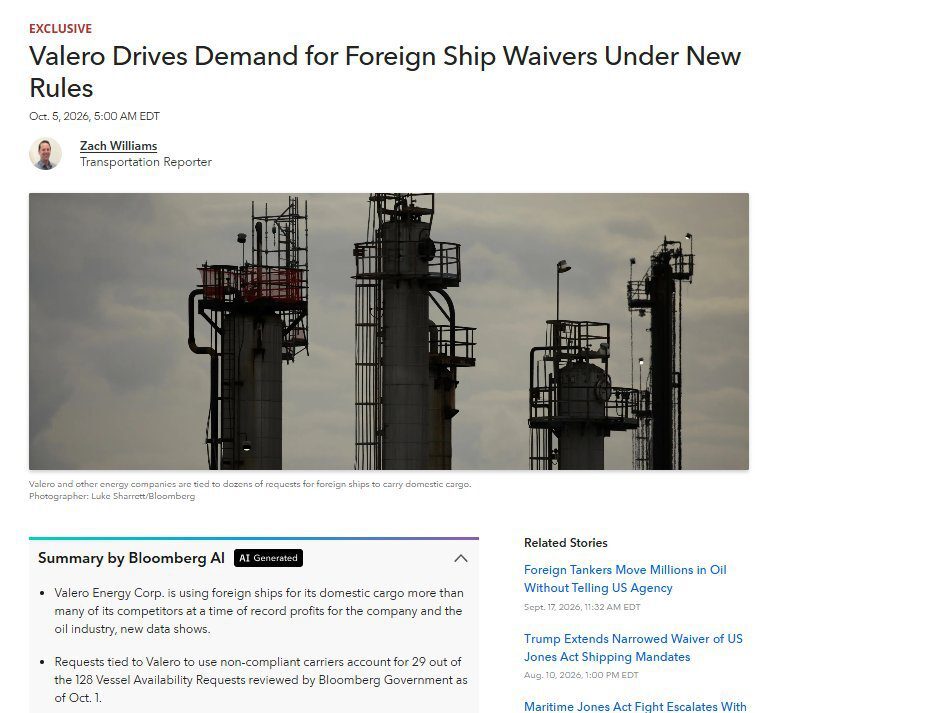
On October 5, 2026, Bloomberg Government published an article reviewing 128 vessel availability requests filed under the Trump Administration’s “case-by-case” Jones Act waiver process. The outlet found that a disproportionate share came from a select few large energy interests, with one alone tied to 29 requests and another to 14. Notably, some of these waiver requests sought shorter movements between Gulf energy hubs that would not directly increase consumer supplies.
Jennifer Carpenter, President of the American Maritime Partnership (AMP), provided the following statement in response to Bloomberg Government’s data.
“The fact that so many waiver requests appear to be coming from a small group of large energy companies underscores our concern that what Congress intended to be extraordinary national defense waiver authority is being used for profit-seeking purposes far removed from the emergency circumstances it was intended to address.
The Department of War has a duty to evaluate whether these requests actually meet the statutory standard of necessity to address “an immediate adverse effect” on military operations.
Since the beginning of the waiver in March, these have been few and far between.
This is particularly apparent when American companies have offered vessels to customers seeking waivers, both before the case-by-case process and since it began in August, yet those customers continue looking to the waiver process as an alternative to normal commercial practice – initiating a waiver request rather than contacting a vessel owner or broker to arrange transportation for a cargo. We are aware of multiple instances in which shippers have declined to use Jones Act-qualified vessels that would normally serve a given trade route and told the American vessel owner they’d “waiver it” instead.
The case-by-case process is an improvement over the blanket waiver, but it has not resolved the fundamental problem for the American maritime industry, or for the Trump Administration’s maritime dominance agenda.
First, American vessel owners continue to be harmed by the ongoing waiver and have lost contracts as shippers opt to try their luck at securing waivers, either to replace American vessels with foreign ones or as a commercial cudgel to drive lower rates. Second, the waiver imposes a ceiling on the growth of the U.S. maritime fleet, the exact opposite of what the Trump Administration hopes to stimulate. If new demand is emerging in certain markets due to war-induced supply chain disruptions, an ongoing Jones Act waiver effectively forecloses the possibility of U.S. vessel owners making the investment in new vessels to serve emerging trades.
The continued use of the political Jones Act waiver warrants transparency and vigorous oversight. We welcome Congressional scrutiny of whether individual requests meet the law’s national defense standard.”
The full article is available to Bloomberg Government subscribers: “Valero Fuels Demand for Foreign Ship Waivers Under New Rules.”
AMP is available for comment to help reporters tell the story of the Jones Act waivers accurately and fairly.
Interested media should email AMP at AMP [@] nahigianstrategies.com.
Comments are closed.