
November 3, 2026
The Honorable Donald J. Trump
President of the United States
The White House
1600 Pennsylvania Avenue, N.W.
Washington, D.C. 20500
Dear President Trump:
On behalf of the American Maritime Partnership and the men and women of the domestic maritime industry, we respectfully urge you to allow the current Jones Act waiver to expire on November 15. The waiver responded to an extraordinary energy disruption, but after eight months, the record is clear: continuation of the waiver threatens to curtail your ambitious agenda to unleash investment that will restore American maritime dominance. We are eager to work with you to advance that agenda, and we urge you to let the waiver expire as scheduled.
Your Administration has been a vocal advocate for the domestic maritime industry, championing American shipbuilding, American mariners, and the restoration of American maritime dominance. Allowing the waiver to expire is essential to avoid unintended consequences that constrain investment in the recapitalization of the American maritime industry and the growth of the American maritime workforce. Ending the waiver would also affirm the America First philosophy that your Administration has led.
Under the original broad waivers, from March to mid-August, American domestic maritime commerce became a “Wild West” for foreign interests. At the same time as your Administration cracked down on violations of Jones Act-style regulations in the trucking industry, the waiver opened U.S. waters and handed off American cargo to vessels linked to Communist China, including companies accused of spying on Americans, and flag-of-convenience vessels crewed by Russian mariners. Foreign companies gained access to domestic trades and substantial commercial opportunities while ignoring U.S. laws, raising serious questions about compliance with U.S. tax, immigration, labor, security and safety laws. American mariners, shipyards, and vessel operators lost work and investment was disrupted while foreign traders made record profits.
The August change to a case-by-case waiver review process was an important step in the right direction. The Maritime Administration and Department of War worked with U.S. vessel owners to identify available American vessels before allowing foreign vessels to operate under the waiver. Your Administration also clarified that foreign waiver users remain subject to U.S. tax laws. As a result, reported foreign vessel movements were reduced while essential cargo continued to flow freely between U.S. ports. We appreciate your Administration’s actions to narrow the scope of the waiver and reduce its negative impacts on the U.S. maritime industry.
After more than 230 days, however, the totality of the record leads to a clear conclusion: the prolonged continuation of a waiver meant to serve as a short-term emergency measure threatens to stymie your Administration’s maritime dominance agenda. We urge you to let the waiver expire on November 15. In the event of a national security emergency that cannot be met by U.S. coastwise-qualified vessels, existing law at 46 USC 501(b) provides a workable case-by-case process that can be used in a timely and surgical manner without sending unintended negative signals that chill domestic maritime investment. Please consider the following:
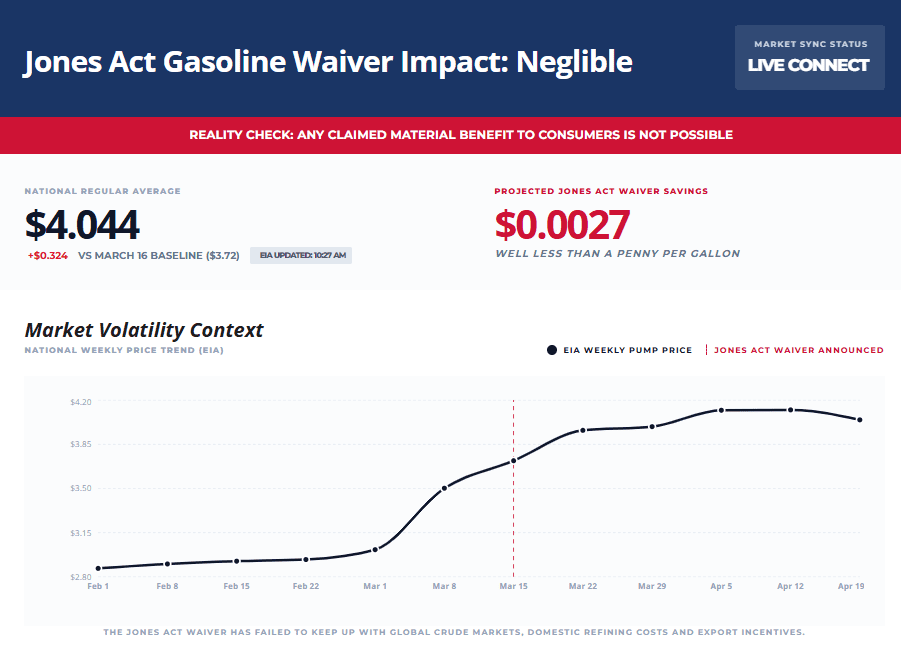
The waiver has not lowered prices for American consumers. After nearly eight months of Jones Act waivers allowing domestic cargo to be moved by foreign vessels, gasoline remains above $4 per gallon nationally and diesel above $6 per gallon. Published analyses have found no demonstrated retail benefit from the waiver and estimated the maximum effect on the price of gasoline to be less than one-half cent per gallon. This is because the waiver cannot reopen global shipping lanes, increase inventories, or change the crude and refining economics that is driving prices. It has changed who makes money carrying certain cargoes, but it has not made fuel cheaper for Americans.
The waiver has benefited foreign adversaries and companies at America’s expense. More than 28 percent of reported waiver voyages were on vessels or companies directly tied to China, including COSCO vessels linked to alleged intelligence-gathering activity. Foreign vessels gained access to sensitive U.S. waterways and critical American cargo, while foreign companies profited and Americans saw no benefit at the pump. Instead of strengthening the American ships, mariners, and shipyards needed for national defense, the waiver gave China’s maritime industrial base a competitive advantage.
The waiver weakened investment in the American maritime industry. Maritime investment depends on long-term contracts, predictable cargo demand, and confidence that domestic trades will remain in domestic hands. Industry participants report more than $2.6 billion in delayed investments in new vessels and shipyard expansion; more than $700 million in planned Jones Act dredging vessel investment has been deferred amid waiver uncertainty; and financial institutions have reassessed lending decisions for domestic vessels. Extending the waiver again would reinforce the uncertainty preventing American companies from financing new vessels, expanding shipyards, and growing the American maritime workforce.
Taken together, the record is decisive. The waiver has not lowered prices. It has opened American commerce to foreign interests, created national security and law enforcement concerns, strengthened China-linked maritime activity, and weakened the investment signal needed to rebuild the American fleet. The case-by-case process in place since August has demonstrated that American vessels and American mariners are available to move U.S. domestic commerce and true emergencies can be addressed in a timely and targeted way under 46 USC 501(b). It is time to end the waiver and return American cargo and American jobs to the American maritime industry.
Mr. President, we respectfully ask you to let the waiver expire on November 15 and stand with the Americans who build, crew, operate, and support our domestic fleet. Let American mariners carry American cargo. Let American shipyards build the vessels America needs. Let American investment strengthen American maritime power. Allowing the waiver to expire will send the unmistakable message that America is serious about restoring its maritime dominance by standing with its own workers, strengthening its own industrial base, and advancing its own national security interests.
Sincerely,
Jennifer Carpenter
President
American Maritime Partnership
Board of Directors
- Jennifer Carpenter, President, The American Waterways Operators
- Sara Fuentes, Vice President, Transportation Institute
- Jim Weakley, Secretary/Treasurer, Lake Carriers’ Association
- Susan Allan, Overseas Shipholding Group, Inc.
- Mark Barker, Interlake Steamship Company
- Beau Berthelot, Maritime Partners
- Scott Clapham, American Petroleum Tankers
- Cary Davis, Pasha Hawaii
- William Doyle, Dredging Contractors of America
- Clay Heil, Crowley Maritime Corporation
- Joe Misenti, TOTE, Inc.
- Brenda Otterson, American Maritime Officers Service
- Ku’uhaku Park, Matson Navigation Company
- Matthew Paxton, Shipbuilders Council of America
- Bryson Person, Nabrico Marine Products
- Trish Skoglund, Fairwater
- Hank Webster, Associated Federal Pilots and Docking Masters of Louisiana
- Matt Woodruff, Kirby Corporation
Comments are closed.