

An analysis of the initial period of the blanket Jones Act waiver covering 659 commodities and 78 voyages reported by MARAD shows no military necessity, no gasoline price relief, and a massive transfer of U.S. cargoes to foreign — including Chinese — ships, while U.S. refiners continue exporting record petroleum volumes.
- The Waiver Is Allowing Increasing Chinese Influence in Domestic Commerce
- Built in: Korea (58.5%), China (23.1%), Japan (12.3%)
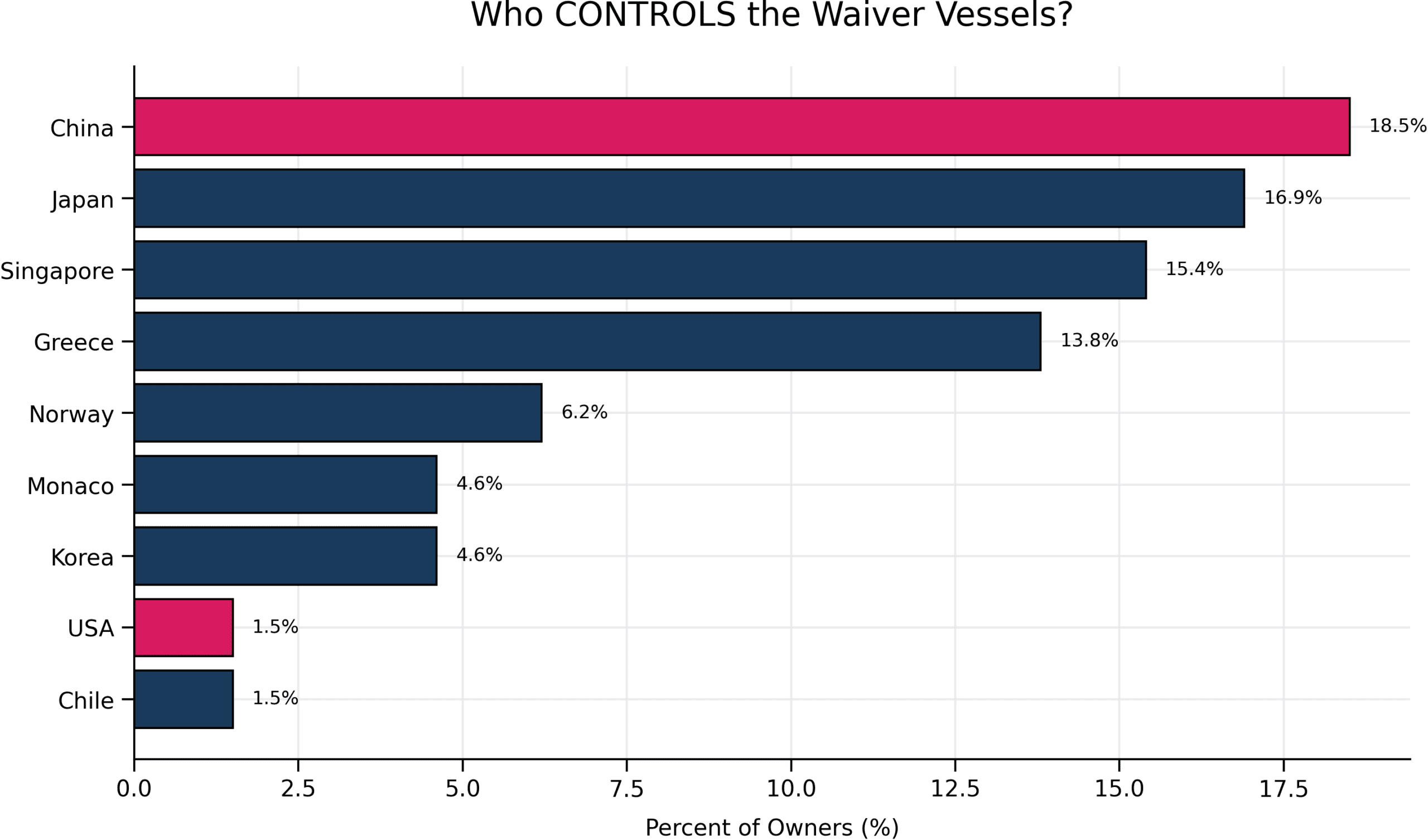
- Controlled by: China (18.5%), Japan (16.9%), Singapore (15.4%), Greece (13.8%).
- No Military Necessity Demonstrated
- ZERO of 78 waiver voyages in MARAD’s June 1, 2026 Report addressed “an immediate adverse effect on military operations.”
- Commercial fuels, blendstocks, and crude oil dominate the movements— none meet DoD’s military specifications (JP-5, JP-8, F-76).
- Jones Act Vessels Were Available
- U.S.-flag tankers, ATBs, and barges were available to perform 87% of the qualifying waiver voyages (58 of 67).
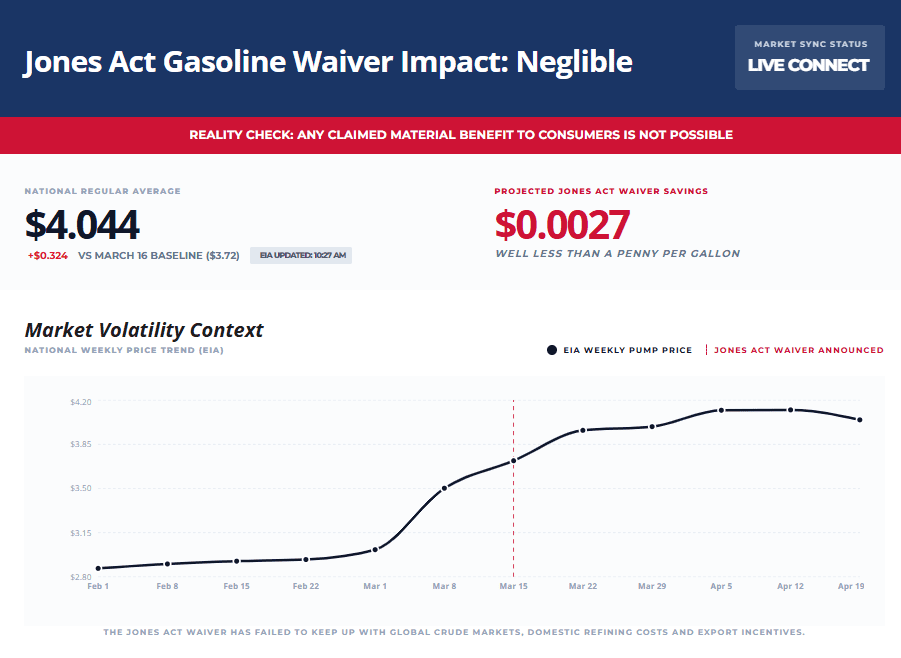
- No Impact on Gasoline Prices
- Only ~6.5% of U.S. gasoline (8.9B of 136.6B gallons in 2025) moves on Jones Act vessels.
- 11-week regression analysis (Mar 23 – Jun 1, 2026) found no credible evidence of price relief at the pump for consumers.
- Foreign-Flag Shipping Rates Often Matched or Exceeded Jones Act Rates During the Analyzed Waiver Period
- New Orleans → Port Everglades (gasoline): Foreign shipping rates: $0.097/gal vs. Jones Act $0.091/gal — Jones Act transportation was cheaper by $0.006.
- Corpus Christi → Philadelphia (crude) shipping rates: Foreign $0.153/gal vs. Jones Act $0.156/gal — near parity (+$0.002).
- Richmond → Los Angeles (products) shipping rates: Foreign $0.047/gal vs. Jones Act $0.071/gal (+$0.024) – two cents that does not appear to be passed along to the consumer.
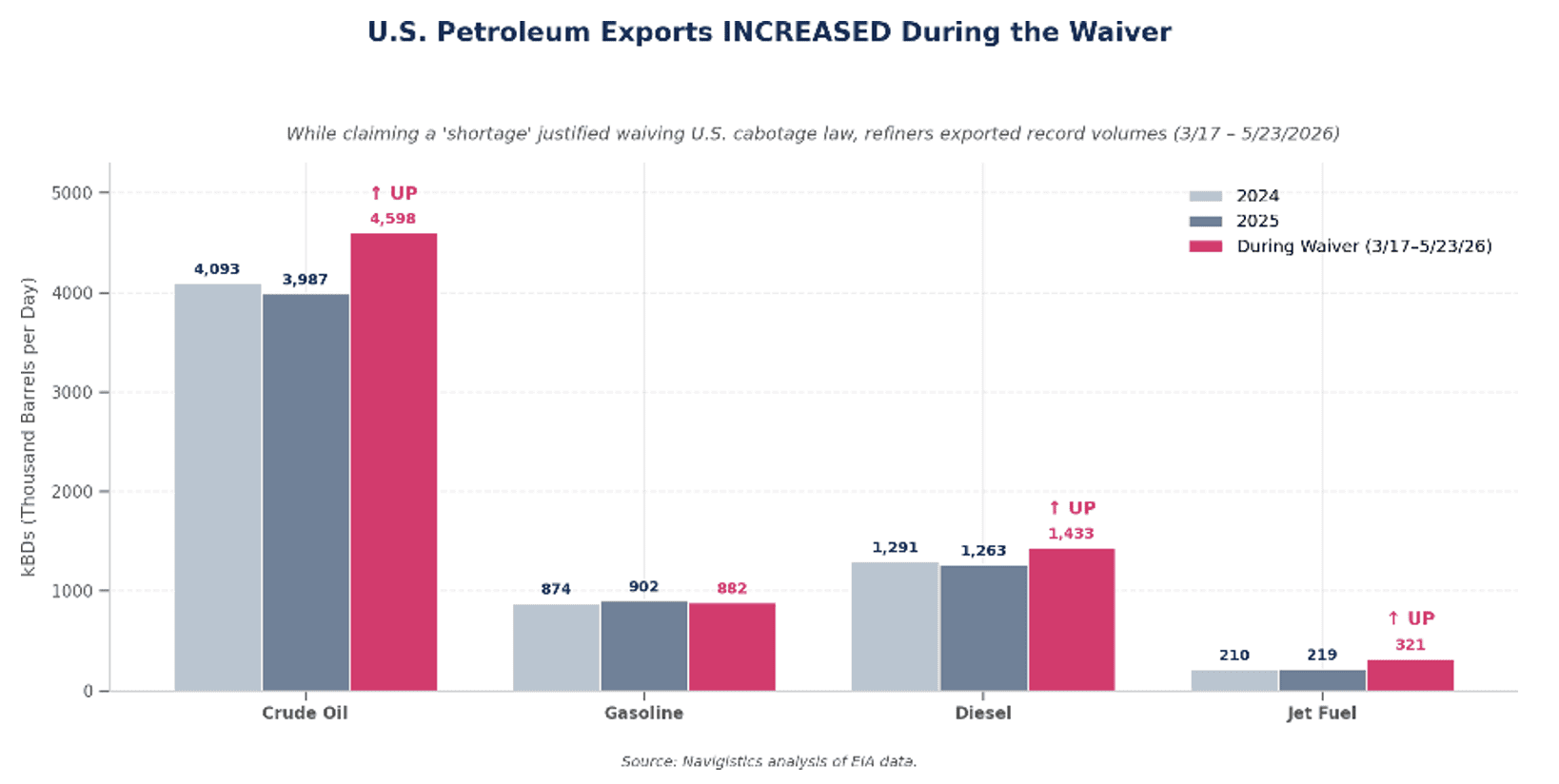
- U.S. Continued Exporting Massive Petroleum Volumes During the “Shortage”
- The U.S. exported ~731 million barrels of petroleum during the waiver window.
- Crude, diesel, and jet fuel exports all INCREASED prior-year baselines — the opposite of what a genuine domestic shortage would produce.
- If domestic supply were truly inadequate, exports would have fallen — they rose. The data show a market-allocation choice by refiners, not a national emergency requiring a Jones Act waiver.
- PADD 5 Supply Strain Is Self-Inflicted — Not a Jones Act Problem
- Four PADD 5 refinery closures removed roughly one-quarter of California’s refining capacity (564 kBDs). PADD 5 gasoline imports surged +123% (73 → 163 kBDs) from 2024 to YTD 2026.
- The refinery closures created the California energy island, not Jones Act transportation requirements.
- Claims the Waiver has Opened “New Trades” Is False
- A vast majority (3%) of the voyages have been performed by single, unique vessels, illustrating that a vast majority are ad hoc usage of the waiver.
- Claims that the waiver established “new” Jones Act trades is refuted by documented historical voyages over the last 12 months showing Jones Act vessels have operated in such trades.
- Long-Duration Blanket Waiver Is Damaging the U.S. Merchant Marine
- A respected ship broker’s report indicates charterers are routinely using “waiver threats” in Jones Act rate negotiations (“Give us this rate or we’ll waiver it”).
- MARAD is not verifying Jones Act vessel availability before granting waivers — damaging the entire fleet and the U.S. mariner workforce DoD relies on for sealift.
TAKEAWAYS:
The waiver is not delivering military necessity, not lowering pump prices, and not unlocking new commerce.
The waiver is transferring U.S. cargoes to Chinese-, Greek-, and Singapore-owned, foreign-flag, foreign-built tankers.
U.S. refiners continue exporting record volumes of crude, gasoline, diesel, and jet fuel, while fuel prices in the U.S. continued to rise.
The real PADD 5 problem is the loss of roughly 25% of West Coast refining capacity, creating a structural import-dependency issue that no Jones Act waiver can fix.
The blanket structure is being weaponized against U.S.-flag operators and mariners — the very fleet that is important to DoD sealift capabilities and manpower.
Source: Navigistics Consulting, Jones Act 2026 Waiver After Action Report and Appendices, June 23, 2026.
Comments are closed.